Doorway Chest Stretch
Opens the chest to counter a rounded, forward posture.
What it helps
Tight chest muscles round the shoulders and push the head forward, loading the neck. Opening them up helps you sit and stand tall, taking strain off the neck.
How to do it
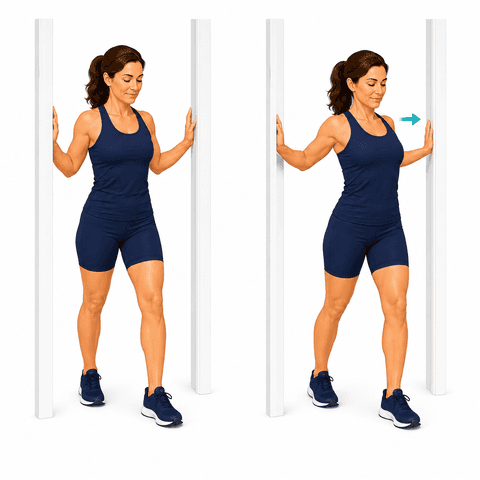
- Stand in a doorway with your forearms resting on the frame, elbows about shoulder height.
- Step one foot through and let your chest ease gently forward until you feel a comfortable stretch across the front of the chest and shoulders.
- Hold, breathing easily, then step back.
Tips
- Keep it comfortable — you should feel a stretch, not a strain.
- Stand tall; don't let the low back arch to chase the stretch.
Commonly done as 2–3 times sets of Hold 20–30 seconds, daily.
Where this appears in recovery
Doorway Chest Stretch is part of 28 recovery programs, most often at the regaining motion (weeks 2–6), early recovery (weeks 2–6) and active motion (months 3–5) stages, among others. Each program shows how it fits alongside the other movements:
- Clavicle Fracture ORIF exercise guide
- Cervical Laminoplasty exercise guide
- Superior Capsular Reconstruction exercise guide
- Revision ACDF exercise guide
- Proximal Humerus Fracture ORIF exercise guide
- Total Shoulder Arthroplasty (Anatomic) exercise guide
- Open Rotator Cuff Repair exercise guide
- Posterior Spinal Fusion for Scoliosis exercise guide
- Revision Total Shoulder Arthroplasty (Both Components) exercise guide
- Anterior Cervical Corpectomy and Fusion exercise guide
- Anterior Cervical Corpectomy and Fusion exercise guide
- Anterior Scoliosis Correction exercise guide
- …and 16 more
All exercise guides · Condition guides · Recovery education
These are general exercise guides, not a personal prescription. The repetitions and frequency shown are what's commonly used — your own surgeon or therapist may advise something different, and their guidance comes first.