Resistance Band External Rotation
Strengthens the rotator cuff muscles that turn the arm outward and steady the shoulder.
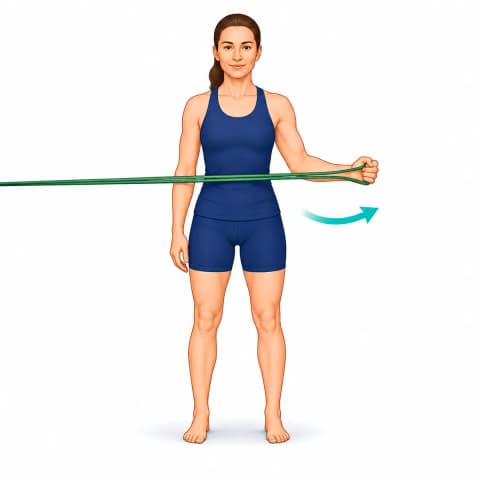
What it helps
Builds the rotator cuff muscles that turn the arm out and hold the ball centered in the socket — the deep stabilizers that keep the shoulder moving smoothly.
How to do it
- Anchor a band at waist height and stand side-on to it, holding the band in the hand furthest from the anchor.
- Bend that elbow to a right angle and tuck it firmly against your side. It stays there for the whole exercise.
- Keeping the elbow pinned, rotate your forearm outward, away from your body.
- Return slowly, still keeping the elbow against your side.
Tips
- The elbow never leaves your side. If it drifts out, you are working the wrong muscles — a small rolled towel held between elbow and ribs makes it obvious.
- Only the forearm moves. Your shoulder, torso and feet stay still.
- Light resistance, slow and controlled. This is a small movement done well, not a big one done fast.
Commonly done as 2–3 sets of 10–15, most days.
Where this appears in recovery
Resistance Band External Rotation is part of 43 recovery programs, most often at the strength building (weeks 6–12), strength building (months 3–6) and advanced strengthening (months 6–9) stages, among others. Each program shows how it fits alongside the other movements:
- Clavicle Fracture ORIF exercise guide
- Latarjet Procedure exercise guide
- Latarjet Procedure exercise guide
- Distal Clavicle Excision exercise guide
- Superior Capsular Reconstruction exercise guide
- Arthroscopic Rotator Cuff Repair exercise guide
- Arthroscopic Rotator Cuff Repair exercise guide
- Distal Biceps Tendon Repair exercise guide
- Proximal Humerus Fracture ORIF exercise guide
- Bankart Repair (Shoulder Stabilization) exercise guide
- Bankart Repair (Shoulder Stabilization) exercise guide
- AC Joint Reconstruction exercise guide
- …and 31 more
All exercise guides · Condition guides · Recovery education
These are general exercise guides, not a personal prescription. The repetitions and frequency shown are what's commonly used — your own surgeon or therapist may advise something different, and their guidance comes first.