Cane-Assisted Shoulder Flexion
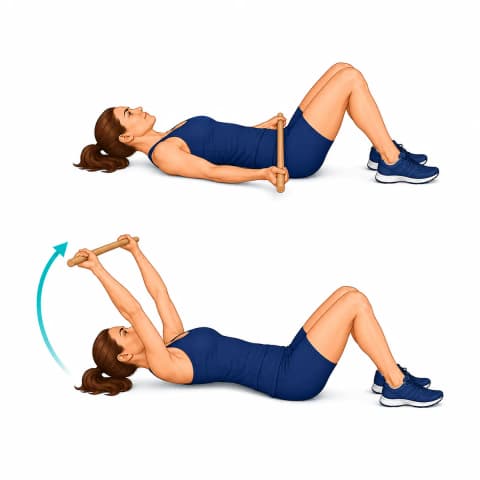
Your good arm lifts the operated one with a stick, so the repaired tendon does no work.
What it helps
Keeps the shoulder moving while the repaired tendon is protected from doing any work. Movement in these early weeks is what prevents the stiffness that is otherwise the hardest part of the recovery to undo.
How to do it
- Lie on your back holding a broom handle, walking stick or length of dowel across your body with both hands, palms up.
- Keep the operated arm completely relaxed — let it be carried.
- Use the good arm to push the stick, raising both arms up over your chest and toward your head.
- Go only as far as is comfortable and as far as your surgeon has allowed, then lower slowly using the good arm to control it.
Tips
- The operated arm is a passenger. If its muscles are working, the exercise is not doing its job.
- Lying down is easier than sitting or standing, because gravity is not fighting you and the arm relaxes more completely.
- Doing this after a warm shower, or after pain relief has taken effect, usually makes it easier.
Commonly done as 2–3 sets of 10–15, daily.
Where this appears in recovery
Cane-Assisted Shoulder Flexion is part of 28 recovery programs, most often at the regaining motion (weeks 2–6), protected healing (weeks 0–3) and immediate motion (weeks 0–2) stages, among others. Each program shows how it fits alongside the other movements:
- Clavicle Fracture ORIF exercise guide
- Latarjet Procedure exercise guide
- Distal Clavicle Excision exercise guide
- Superior Capsular Reconstruction exercise guide
- Arthroscopic Rotator Cuff Repair exercise guide
- Arthroscopic Rotator Cuff Repair exercise guide
- Proximal Humerus Fracture ORIF exercise guide
- Proximal Humerus Fracture ORIF exercise guide
- Bankart Repair (Shoulder Stabilization) exercise guide
- Bankart Repair (Shoulder Stabilization) exercise guide
- AC Joint Reconstruction exercise guide
- AC Joint Reconstruction exercise guide
- …and 16 more
All exercise guides · Condition guides · Recovery education
These are general exercise guides, not a personal prescription. The repetitions and frequency shown are what's commonly used — your own surgeon or therapist may advise something different, and their guidance comes first.