Cane-Assisted External Rotation
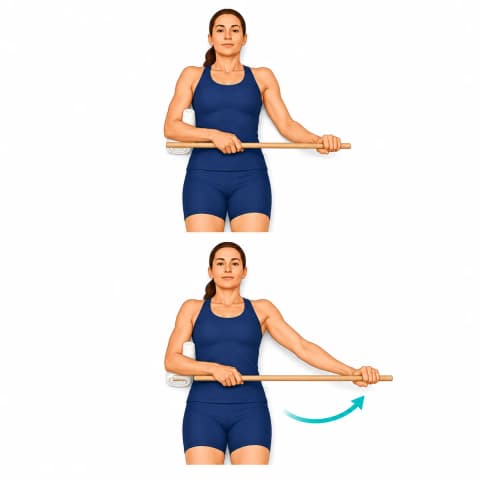
Passive turning of the arm outward, powered entirely by the good arm.
What it helps
Preserves the outward rotation of the shoulder, which is the movement most commonly lost after a rotator cuff repair and the hardest to regain once it has gone. Doing it passively means the repair is not loaded.
How to do it
- Lie on your back, sit, or stand with the operated elbow tucked against your side, bent to a right angle. A rolled towel between elbow and body helps.
- Hold a stick across your body with both hands.
- Keeping the elbow against your side, use the good arm to push the stick so the operated forearm rotates outward, away from your stomach.
- Go only to the limit your surgeon has set, hold briefly, then let the good arm bring it back.
Tips
- The elbow stays glued to your side. Letting it drift away from the body turns this into a different, less useful movement.
- Your surgeon may have set a specific limit on how far out to go — that limit protects the repair and is worth following exactly.
- Keep the operated arm relaxed throughout; the good arm is doing all of the work.
Commonly done as 2–3 sets of 10–15, daily.
Where this appears in recovery
Cane-Assisted External Rotation is part of 21 recovery programs, most often at the regaining motion (weeks 2–6), bone healing (weeks 3–12) and immediate motion (weeks 0–2) stages, among others. Each program shows how it fits alongside the other movements:
- Clavicle Fracture ORIF exercise guide
- Latarjet Procedure exercise guide
- Distal Clavicle Excision exercise guide
- Superior Capsular Reconstruction exercise guide
- Arthroscopic Rotator Cuff Repair exercise guide
- Arthroscopic Rotator Cuff Repair exercise guide
- Proximal Humerus Fracture ORIF exercise guide
- Bankart Repair (Shoulder Stabilization) exercise guide
- AC Joint Reconstruction exercise guide
- Total Shoulder Arthroplasty (Anatomic) exercise guide
- Total Shoulder Arthroplasty (Anatomic) exercise guide
- SLAP Repair exercise guide
- …and 9 more
All exercise guides · Condition guides · Recovery education
These are general exercise guides, not a personal prescription. The repetitions and frequency shown are what's commonly used — your own surgeon or therapist may advise something different, and their guidance comes first.